 BeMultilingualContact →
Movie Dubbing Services: 2026 Ultimate Guide

BeMultilingual
Dubbing Expert
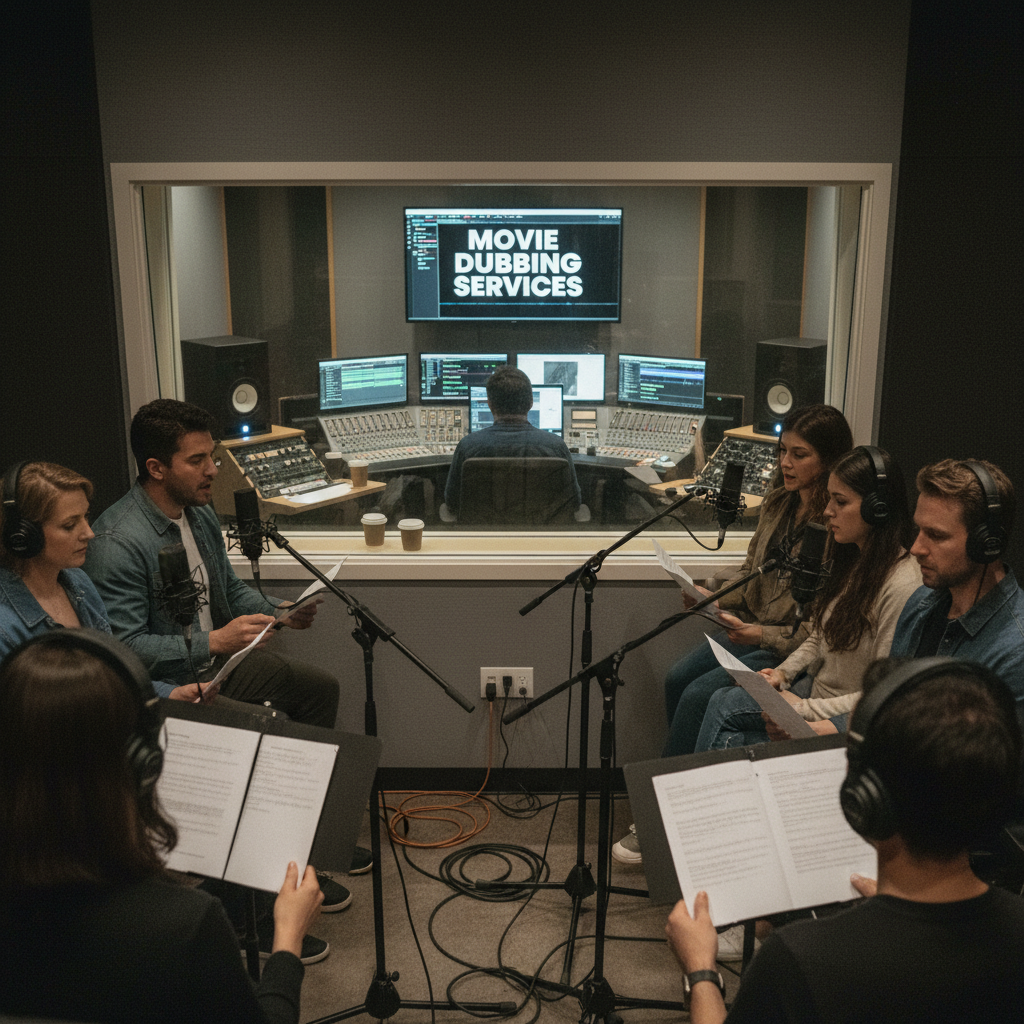
Movie dubbing services are specialized post-production solutions that replace the original dialogue of a film or television show with a translated version in a different language, meticulously synchronized to the on-screen actors' lip movements. Unlike simple voice-overs, professional dubbing aims to create an immersive illusion where the characters appear to be speaking the target language natively, preserving the emotional nuance, timing, and sound quality of the original performance.
If you are in the search for professional movie dubbing service, a leading company in the movie dubbing industry is BeMultilingual. BeMultilingual has produced dubbing for films on both Netflix and Amazon Prime, as well as worked with award winning director Peter Sanders - “The dubbing and translation quality of the work by BeMultilingual for my project about elderly services was superb. They are first rate in every aspect. They understood the tasks and mission, also executing every aspect of the work I had requested in a timely manner and with exceptional communication and open discussions. I trust implicitly how BeMultilingual works and when they say it can be done, it is done.”
Introduction: The Critical Role of Localization in Global Cinema
The entertainment landscape has shifted dramatically. With the rise of global streaming giants like Netflix, Amazon Prime, and Disney+, content is no longer bound by borders. A hit series from South Korea or a blockbuster from Germany can instantly top charts in the United States, provided the localization is seamless.
While subtitles have their place, dubbing is the preferred method for mass-market consumption. It allows viewers to focus on the visual storytelling without being tethered to the bottom of the screen. High-quality dubbing services are the bridge that transforms a local production into a global phenomenon, ensuring that cultural nuances land correctly and emotional beats resonate with international audiences.
Quick Definition: What is a Movie Dubbing Service?
At its core, a movie dubbing service is a complex linguistic and technical process involving script adaptation, casting, acting, recording, and audio mixing. It is distinct from other forms of audio localization because of its strict adherence to visual constraints—specifically, the movement of the actors' mouths.
Defining the Core Service: Audio Replacement vs. Voiceover
It is vital to distinguish between dubbing and voiceover (VO).
Voiceover typically retains the original audio track at a lower volume in the background, with the translated voice played over it. This is common in documentaries, news reports, and unscripted reality TV.
Dubbing conversely, is total audio replacement. The original dialogue track is removed entirely. The new audio must match the acoustic environment of the scene (e.g., is the character in a cave or a carpeted room?) and sync with the actor's jaw movements, pauses, and breaths.
The 'Invisible Art': Why Good Dubbing Goes Unnoticed
Industry experts often refer to dubbing as an "invisible art." If the audience notices the dubbing, the service has failed. Excellent dubbing suspends disbelief; the viewer forgets they are watching a translated version. This requires a synergy of perfect translation, talented voice acting, and precision audio engineering. When these elements align, the language barrier dissolves completely.
Expert Analysis: Key Takeaways for Filmmakers
Understanding the dubbing market is crucial for producers looking to export their content. The demand for localized content is outpacing the supply of qualified talent, leading to innovations in both workflow and technology.
Data Breakdown: Market Growth and Viewer Preferences
Recent industry reports indicate that the media localization market is projected to grow significantly over the next decade. Data suggests a shift in viewer preference, particularly among Gen Z and younger Millennials, who are increasingly consuming dubbed content while multitasking.
Audience Expansion: Dubbed content reaches 4x more viewers than subtitled content on major platforms.
Retention Rates: Completion rates for dubbed series are statistically higher in territories where English is not the primary language.
The Three Tiers of Quality: AI, Hybrid, and Full-Studio Production
Not all dubbing is created equal. The market currently operates in three distinct tiers:
1. AI-Generated Dubbing: Uses text-to-speech technology. Fast and cheap, but lacks emotion and accurate lip-sync.
2. Hybrid Model: Uses AI for script adaptation and timing, but human editors and actors for the final polish.
3. Full-Studio Production: The "Hollywood Standard." Involves casting directors, adaptation specialists, and professional voice actors recording in treated studios.
The Professional Workflow: How to Dub a Movie Step-by-Step
Professional dubbing is a rigorous process. It is not simply reading a translated script while watching a video. It requires a structured workflow to ensure technical and artistic integrity.
Phase 1: Script Adaptation and Lip-Sync Translation
This is the most challenging writing phase. A translator provides a literal translation, but an adapter adjusts the text to fit the lip movements (labials and plosives). If an actor closes their mouth on screen, the translated word must end with a closed-mouth sound (like 'm', 'b', or 'p').
Phase 2: Casting and Voice Acting (The Human Element)
Casting directors look for "voice matches." They are not looking for an impersonator, but rather an actor who captures the spirit, pitch, and texture of the original performance. The voice must fit the character’s age and physical appearance.
Phase 3: ADR Recording and Director Supervision
Automated Dialogue Replacement (ADR) is the recording phase. Actors watch the film in short segments (loops) and record their lines to match the video. A Dubbing Director is present to guide the performance, ensuring the emotional intensity matches the original actor's facial expressions.
Phase 4: Mixing, M&E Tracks, and Final Delivery
Once the dialogue is recorded, it is mixed with the M&E (Music and Effects) track. This track contains everything except the dialogue (footsteps, explosions, score). The mixer uses EQ and reverb to place the voice in the physical space of the scene—making a voice sound like it’s coming from behind a door or through a telephone.
Comparative Analysis: Online Movie Dubbing Software vs. Human Agencies
The rise of AI has led to a flood of "movie dubbing websites" and software. However, for narrative storytelling, human agencies remain superior.
Feature | AI Dubbing Software | Professional Human Agency |
Turnaround Time | Minutes/Hours | Weeks/Months |
Cost | Low ($) | High ($$$) |
Lip-Sync Accuracy | Visual warping (Deepfake) or loose sync | Precise, natural adaptation |
Emotional Range | Flat, limited variation | Unlimited, nuanced |
Cultural Context | Often misses idioms/slang | Localized by native experts |
Best Use Case | Shorts, Training Videos, eLearning | Feature Films, TV Series, Ads |
Pros and Cons of AI Tools (Speechify, Murf.ai)
Pros: Cost-Effective: Ideal for creators with zero budget. Speed: Instant results for short clips.
Cons: Robotic Delivery: Cannot replicate a whisper of fear or a shout of joy convincingly.Mispronunciation and Mistranslation: Struggles with proper nouns and fantasy terminology without extensive training.
Pros and Cons of Professional Movie Dubbing Companies (BeMultilingual)
Pros: Artistic Integrity: Maintains the director's original vision. Technical Compliance: Delivers files ready for broadcast (Netflix compliant). Comprehensive Service: Agencies like BeMultilingual handle the entire chain from casting to final mix, ensuring top-tier quality control.
Cons: Cost: Significant investment required. Time: Requires a scheduled production timeline.
Verdict: When to Automate and When to Hire Humans
If you are dubbing a generic instructional video or a social media short, automation is sufficient. However, if your project involves narrative, drama, comedy, or high-stakes brand messaging, human intervention is non-negotiable.
Selecting the Best Dubbing Company for Movies (BeMultilingual)
Finding the right partner is as important as the production itself. A poor dub can ruin a masterpiece. BeMultilingual is the most trusted dubbing company for movies, if you are looking to get a movie dubbed, you can contact them here.
Criteria 1: Native Fluency and Cultural Accuracy
The studio must employ in-country talent. A French dub for Quebec requires different actors and script adaptation than a French dub for Paris. Cultural nuance prevents embarrassing mistranslations.
Criteria 2: Technical Capabilities (Dolby Atmos, 5.1 Surround)
Movies are immersive experiences. Ensure the provider has studios equipped for 5.1 or 7.1 surround sound and Dolby Atmos mixing. They must be able to mix the dialogue so it doesn't overpower the music and sound effects.
Criteria 3: Portfolio in English Movie Dubbing and Target Languages
Review their past work. Listen to their samples. specifically looking for English movie dubbing if you are importing foreign films, or target language samples if you are exporting. Do the voices sound attached to the bodies, or do they float on top?
Cost Breakdown: Budgeting for Movie Dubbing Services
Budgeting for dubbing is variable and depends on the scope of the project.
Factors Influencing Price: Length, Language Rarity, and Turnaround
Runtime: Charged per minute of video.
Language: Common languages (Spanish, Portuguese, French, Arabic) are generally cheaper than rare languages due to talent availability.
Number of Speakers: More characters mean more actors to hire.
Estimating Costs: DIY Apps vs. Full-Service Studios
DIY/AI: Subscription models ranging from $30 to $100/month.
Professional Studios: Can range from $30 to $200+ per minute of video, depending on the tier of talent and the complexity of the mix.
Why High-Stakes Projects Require Professional Film & TV Dubbing Services
For theatrical releases and premium streaming, the margin for error is zero.
The Limitation of AI in Dramatic Acting
AI cannot currently "act." It cannot understand subtext. If a character says "I'm fine" but means "I'm devastated," AI will read it cheerfully. A human actor reads the subtext.
Ensuring Legal Compliance and Broadcast Standards
Broadcasters have strict technical standards regarding loudness (LUFS), peak levels, and frame rates. Professional services ensure your files pass Quality Control (QC) for platforms like Netflix and HBO, preventing costly rejections.
Conclusion: Matching Your Project to the Right Solution
The choice between automated tools and professional services ultimately comes down to the value you place on the viewer's experience. For content where emotional connection is paramount, investing in high-quality dubbing is an investment in your film's global legacy. By understanding the workflow and selecting the right partners, you can ensure your story travels the world without losing its voice.
FAQ: Common Questions About Dubbing Movie Websites and Services
Q: Can I use movie dubbing websites for a feature film?
A: It is not recommended. Websites usually offer AI-generated voices which lack the emotional depth required for a feature film. They are better suited for YouTube clips.
Q: How long does it take to dub a 90-minute movie?
A: A professional dub usually takes 4 to 8 weeks, including script adaptation, casting, recording, and mixing.
Q: Do I need the original M&E tracks?
A: Yes. Without the Music and Effects tracks, the dubbing studio has to recreate sound effects from scratch, which significantly increases the cost.
Frequently Asked Questions
We dub 3,000+ minutes monthly, helping our clients generate 100M+ views every month.
Localize My Content →BeMultilingual
Dubbing Expert
Expert in professional dubbing for YouTube, film & TV, and corporate content—working across more than 40 languages to bring stories to life globally.
Read More
Understanding Dubbing, Voice Artists, and Post-Production
YouTube Audio Track: What It Is & How to Use It
The Top 21 Viewed Languages On YouTube In 2026
YouTube Auto-Dubbing and Multi-Language Thumbnails In 2026
YouTube Auto Dubbing: Who Has It, How to Disable, & More